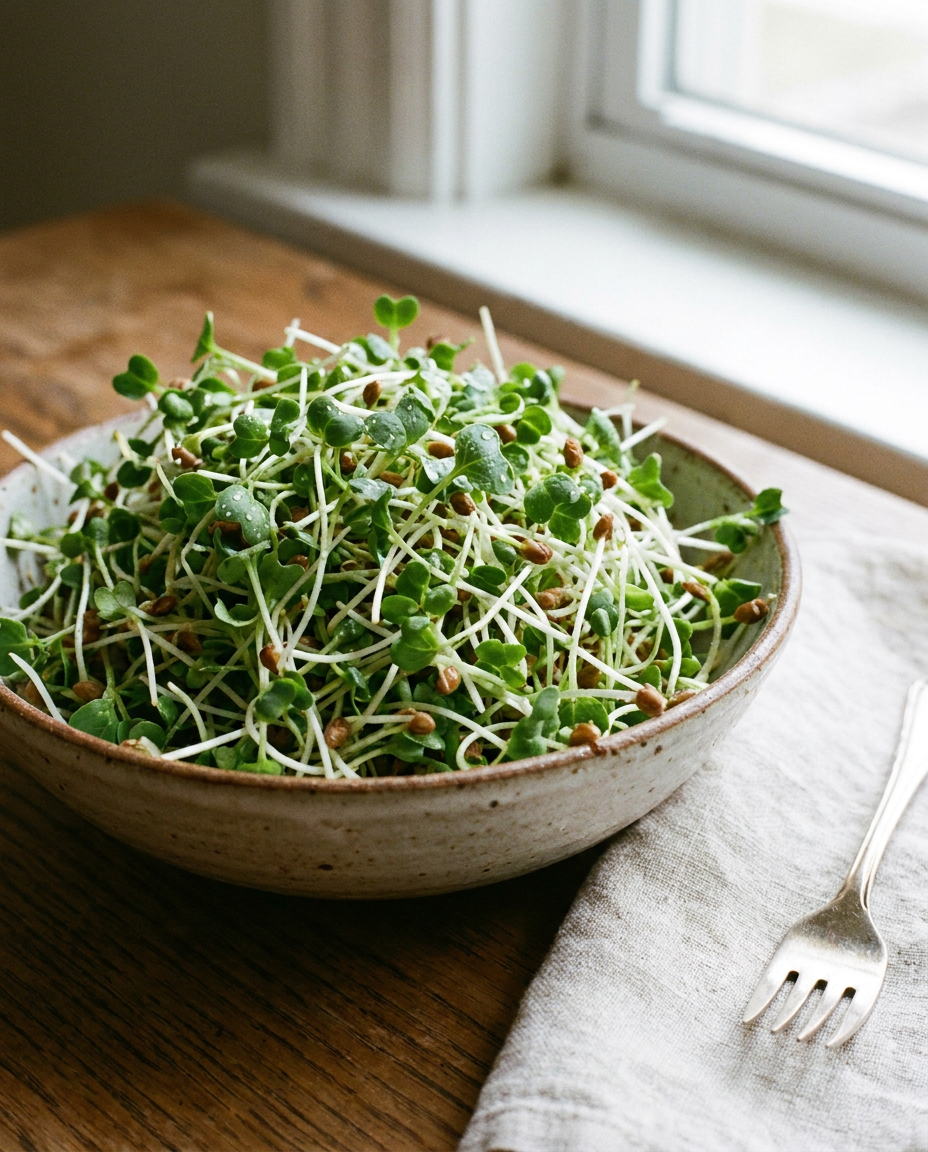
Broccoli Sprouts: The Tiny Superfood With Remarkable Health Potential
Broccoli has long been considered one of the healthiest vegetables you can put on your plate. But its much smaller relative—broccoli sprouts—has attracted increasing attention from researchers because it contains unusually high concentrations of compounds associated with cellular protection and overall health.
Broccoli sprouts are young broccoli plants, typically harvested just a few days after germination. They look more like alfalfa sprouts than mature broccoli, with thin white stems and small green leaves. Their nutritional profile, however, is surprisingly powerful.
Much of the excitement surrounding broccoli sprouts centers on one compound: sulforaphane.
What Makes Broccoli Sprouts Special?
Broccoli sprouts contain high concentrations of glucoraphanin, a naturally occurring glucosinolate. When the plant is chopped, chewed, crushed, or otherwise damaged, an enzyme called myrosinase helps convert glucoraphanin into sulforaphane.
Sulforaphane has become the subject of considerable scientific research because of its effects on cellular defense mechanisms.
Mature broccoli also contains glucoraphanin, but young broccoli sprouts can contain substantially higher concentrations of glucoraphanin than mature broccoli.
This makes broccoli sprouts one of the most concentrated dietary sources of the precursors needed to produce sulforaphane.
- Supports the Body’s Natural Antioxidant Defenses
One of the most interesting aspects of sulforaphane is that it doesn’t simply behave like a conventional antioxidant.
Instead, sulforaphane can activate a cellular pathway involving a protein known as Nrf2.
Nrf2 functions somewhat like a biological switch. When activated, it influences genes involved in antioxidant defenses, detoxification enzymes, cellular protection, and responses to oxidative stress.
Rather than supplying only temporary antioxidant activity, sulforaphane may therefore help stimulate some of the body’s own protective mechanisms.
This is one reason broccoli sprouts have generated significant interest in nutritional and cellular-health research.
- May Help the Body Process Certain Environmental Compounds
Every day, humans encounter compounds from pollution, smoke, food preparation, household chemicals, and the surrounding environment.
The body has sophisticated enzyme systems that help process and eliminate many of these substances.
Sulforaphane has been studied for its ability to influence certain phase II detoxification enzymes, which participate in these natural cellular defense processes.
Human research has even examined broccoli-sprout beverages in populations exposed to significant air pollution. Some studies have found increased excretion of metabolites associated with certain airborne pollutants.
This doesn’t mean broccoli sprouts “detox” the body in the way that term is sometimes used in marketing. The liver, kidneys, lungs, digestive system, and other biological systems already handle detoxification.
A more accurate description is that compounds in broccoli sprouts may support some of the body’s existing protective and metabolic pathways.
- May Support Cardiovascular and Metabolic Health
Researchers have also investigated sulforaphane and broccoli sprouts in relation to metabolic health.
Studies have explored possible effects on insulin sensitivity, blood glucose regulation, oxidative stress, inflammation, cholesterol, and vascular function.
Some human trials involving people with metabolic disorders have produced encouraging findings, although the evidence is not strong enough to consider broccoli sprouts a treatment for diabetes or cardiovascular disease.
Instead, they may represent another beneficial food within a dietary pattern emphasizing vegetables, fruits, legumes, whole grains, nuts, seeds, and other minimally processed foods.
- Broccoli Sprouts and Cancer Research
Perhaps the most widely discussed area of sulforaphane research involves cancer.
Laboratory and animal studies suggest that sulforaphane can influence several biological processes associated with cancer development, including cellular detoxification, oxidative stress, inflammation, cell-cycle regulation, and programmed cell death.
Researchers have investigated its potential relevance to several cancers, including prostate, breast, colorectal, bladder, and others.
However, an important distinction must be made.
Evidence that sulforaphane affects cancer-related pathways does not mean that broccoli sprouts prevent or cure cancer in humans.
Cancer biology is extraordinarily complex, and laboratory findings do not automatically translate into clinical outcomes.
Broccoli sprouts are therefore best viewed as a nutritious food containing compounds of significant scientific interest—not as an alternative to cancer screening, prevention strategies, or medical treatment.
- Potential Benefits for Brain Health
Sulforaphane’s influence on oxidative stress and inflammatory signaling has also made it interesting to neuroscience researchers.
The brain consumes large amounts of oxygen and is particularly sensitive to oxidative damage. Scientists are investigating whether activating cellular defense pathways such as Nrf2 could potentially provide neuroprotective effects.
Research has examined sulforaphane in connection with cognition, neurological disorders, neuroinflammation, and other aspects of brain health.
Some research is promising, but many of these applications remain experimental. More high-quality human studies are needed before strong conclusions can be drawn.
- May Support a Healthy Inflammatory Response
Inflammation isn’t inherently harmful. It is an essential component of the immune system and helps the body respond to infection and injury.
Problems can develop when inflammatory signaling becomes chronically elevated.
Sulforaphane has demonstrated effects on several molecular pathways involved in inflammatory responses. Researchers are therefore investigating whether regular consumption of cruciferous vegetables and their bioactive compounds may contribute to healthier inflammatory regulation.
This could potentially be relevant to cardiovascular, metabolic, neurological, and general health.
Again, broccoli sprouts should be viewed as part of an overall healthy lifestyle rather than a treatment for inflammatory diseases.
- Possible Digestive and Gut Health Benefits
Broccoli sprouts may also interact with the digestive system in interesting ways.
One area researchers have investigated is Helicobacter pylori, commonly called H. pylori, a bacterium capable of colonizing the stomach and contributing to ulcers and other gastrointestinal problems.
Some human research suggests that consuming broccoli sprouts may temporarily reduce markers associated with H. pylori colonization.
However, broccoli sprouts are not a substitute for medical treatment of an H. pylori infection. Standard antibiotic-based treatment remains important when clinically indicated.
Broccoli sprouts also contain plant compounds and small amounts of fiber that can interact with the intestinal microbiome, another rapidly developing area of nutritional research.
Why Sprouts Instead of Regular Broccoli?
Both are excellent foods.
Mature broccoli provides fiber, vitamin C, vitamin K, folate, carotenoids, minerals, and numerous phytochemicals.
Broccoli sprouts provide something somewhat different: an especially concentrated source of glucoraphanin and the potential for substantial sulforaphane formation.
You don’t necessarily have to choose between them.
Eating both mature cruciferous vegetables and sprouts can provide a wider range of nutrients and phytochemicals.
Other members of the cruciferous vegetable family include Brussels sprouts, cauliflower, cabbage, kale, bok choy, arugula, mustard greens, and radishes.
The Importance of Myrosinase
There’s an interesting catch when it comes to obtaining sulforaphane from food.
Glucoraphanin needs the enzyme myrosinase for efficient conversion into sulforaphane.
Cooking can reduce myrosinase activity, particularly when vegetables are exposed to high temperatures for extended periods.
This is one reason raw broccoli sprouts can be an effective dietary source of sulforaphane.
With cooked broccoli, researchers have also investigated strategies such as adding a small amount of raw mustard seed powder or other foods containing active myrosinase.
The chemistry illustrates an important lesson about nutrition: the amount of a compound present in food isn’t necessarily the same as the amount the body ultimately receives.
Preparation matters.
How to Eat Broccoli Sprouts
Broccoli sprouts have a fresh, slightly peppery flavor and require very little preparation.
They can be added to salads, sandwiches, wraps, grain bowls, omelets, smoothies, avocado toast, or other meals. They can also simply be eaten as a small side serving.
Because sprouts are typically consumed raw, however, food safety deserves special attention.
An Important Food-Safety Consideration
Raw sprouts have historically been associated with outbreaks of foodborne illness.
The warm and humid conditions needed to germinate seeds are unfortunately also favorable for bacteria such as Salmonella, E. coli, and Listeria.
Washing sprouts can reduce surface contamination but cannot guarantee that harmful bacteria have been eliminated.
Young children, pregnant individuals, older adults, and people with weakened immune systems are generally advised to be particularly cautious about consuming raw or lightly cooked sprouts. Thorough cooking reduces the risk of foodborne illness, although heating can also affect myrosinase activity.
Anyone growing broccoli sprouts at home should therefore follow careful sanitation and food-handling procedures.
Food First or Supplements?
Sulforaphane supplements have become increasingly popular, but supplements introduce another complication.
A bottle containing “broccoli extract” does not necessarily deliver the same amount of bioavailable sulforaphane as another product.
The result can depend on whether the supplement contains glucoraphanin, stabilized sulforaphane, active myrosinase, or some combination of these ingredients.
For most people simply interested in improving their diet, whole broccoli sprouts provide the additional advantages associated with eating an actual plant food.
Anyone considering concentrated supplements—particularly people taking medications or managing medical conditions—should discuss them with an appropriate healthcare professional.
Small Plant, Fascinating Biology
Broccoli sprouts are a good example of why nutrition is about more than vitamins and minerals.
Plants contain thousands of biologically active compounds that interact with human biology in complicated ways. Sulforaphane is particularly interesting because it appears capable of influencing some of the body’s own cellular defense systems.
Research continues into its potential relationship with antioxidant defenses, detoxification enzymes, metabolic health, cardiovascular health, inflammation, brain health, gastrointestinal health, and cancer-related biological pathways.
Not every proposed benefit has been proven, and broccoli sprouts should not be treated as medicine or a miracle food.
But they don’t need to be.
Adding a small amount of broccoli sprouts to an already healthy diet is a relatively simple way to consume one of the most intriguing groups of phytochemicals currently being studied in nutritional science.
Sometimes an impressive amount of biology can be packed into a very small plant.
This article is intended for educational purposes only and is not medical advice. Individuals with medical conditions, compromised immune systems, or questions about supplements or dietary changes should consult an appropriate healthcare professional.

Related Posts